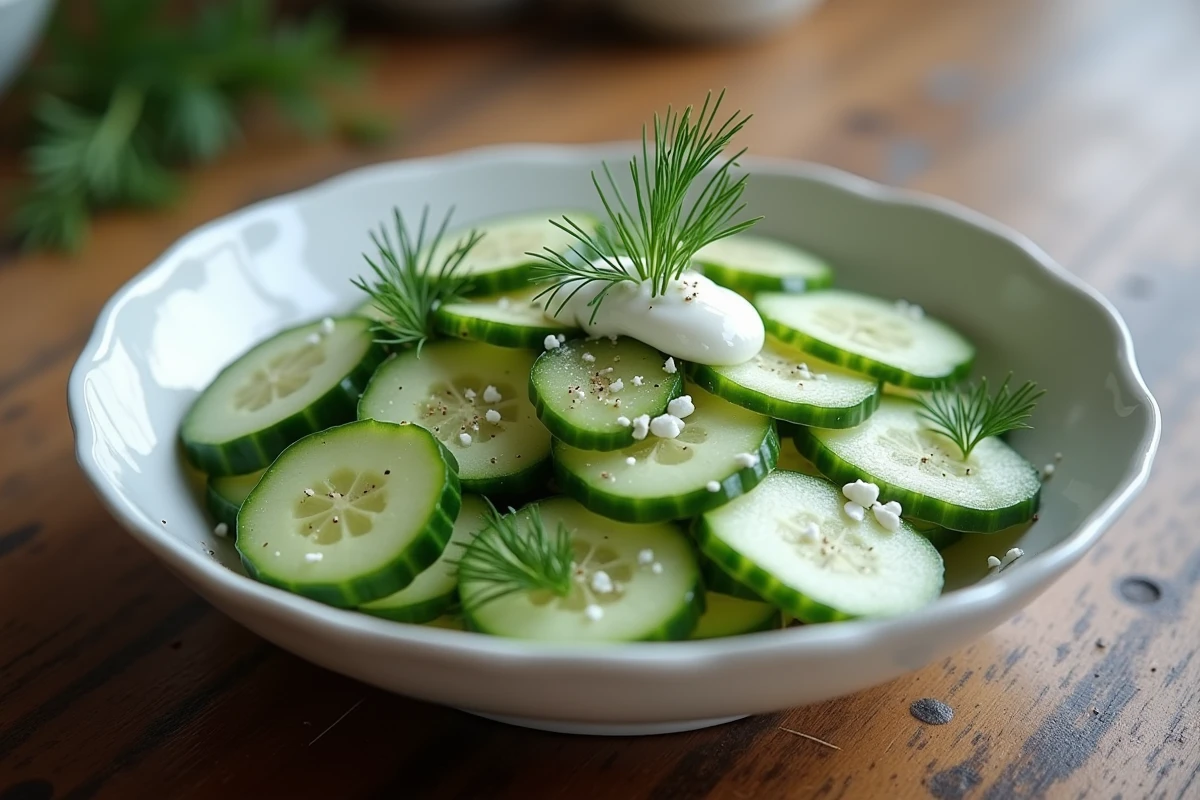
When preparing cucumber with cream in summer, one replicates a culinary gesture whose roots go back much further than a simple seasonal reflex. This cold salad, omnipresent on French family tables, conceals a journey that crosses several borders and centuries before becoming ingrained in our habits.
Cucumber with cream: a recipe inherited from Central Europe
We spontaneously associate cucumber with cream with French bistro cuisine. The reality is more complex. Several food historians, including Julia Csergo in Eating in Europe, stories of cuisines and food cultures (CNRS Éditions, 2019), emphasize that the French version stabilized under the influence of Ashkenazi communities and Central Europe.
In Poland, Hungary, and Germany, salads of cucumber with sour cream, kefir, or smetana have existed for centuries. Claudia Roden, in The Jewish Cuisine of Central Europe (Flammarion, 2013), notes very close parallels with the versions that appeared at Parisian Ashkenazi caterers as early as the interwar period.
This culinary blending explains a particularity still found in some recipes: the addition of a hint of vinegar or lemon to recall the acidity of the original sour cream. This detail is documented on the website La Cuisine de Watoote, which traces this journey between Eastern European traditions and French plates.

Cucumber with cream in bistros: disappearance and return to favor
Cucumber with cream experienced a notable dip in popularity in French dining. During the 1990s and 2000s, it had practically disappeared from menus. Too simple, too associated with Sunday meals, it was perceived as a dish lacking gastronomic ambition.
The turnaround began in the mid-2010s. Parisian neo-bistros reintroduced cucumber with cream, but with a different positioning. It is now found as a cold garnish for smoked fish or gravlax, often with a lighter cream or whipped Greek yogurt.
Chronicles in the magazine 180°C and the show “On va déguster” on France Inter documented this return between 2018 and 2023. Cucumber with cream has become an acknowledged seasonal marker, served between May and September, sometimes enhanced with fresh dill or mustard seeds.
What has changed on the plate
The contemporary version differs from the family recipe in several concrete ways:
- Thick fresh cream is often replaced by Greek yogurt or a cream-yogurt mix, which lightens the texture without losing creaminess
- The salting process, once systematic for an hour or more, is shortened or eliminated to maintain crunchiness
- Herbs diversify: beyond parsley and chives, dill, scallions, and even coriander appear in some fusion versions
The essence of the gesture remains the same. We slice, season, and mix. The difference lies in the dosage and intention: a structured accompaniment rather than a side salad.
Salting technique: a gesture that still divides cooks
The salting of cucumber is probably the technical point on which opinions vary the most. Slices are salted, left to release their water, then pressed before adding the cream. The principle is simple, but the duration and method are debated.
Some cooks let the cucumber drain for about twenty minutes in the refrigerator. Others extend it to an hour. Too long a salting produces soft slices that absorb seasoning poorly. Too short, the cucumber’s water dilutes the cream in a few minutes, turning the dish into soup.
In practice, a good result is achieved by lightly salting the slices, placing them in a colander, and letting them rest for about thirty minutes. The final pressing, by hand or between two plates, makes a difference. The goal is to remove excess water without crushing the flesh.
The choice of cut
The shape of the slice influences the final result more than one might think. Thin rounds (two to three millimeters) drain quickly and coat evenly with cream. Thicker slices retain crunch but cling less to the sauce.
Some bistronomic versions adopt a half-moon or ribbon cut (using a mandoline), which changes the texture in the mouth. The mandoline offers a consistency impossible to achieve with a knife, and it is this uniform thickness that ensures even seasoning.
Fresh cream, sour cream, or yogurt: what binder for the cucumber
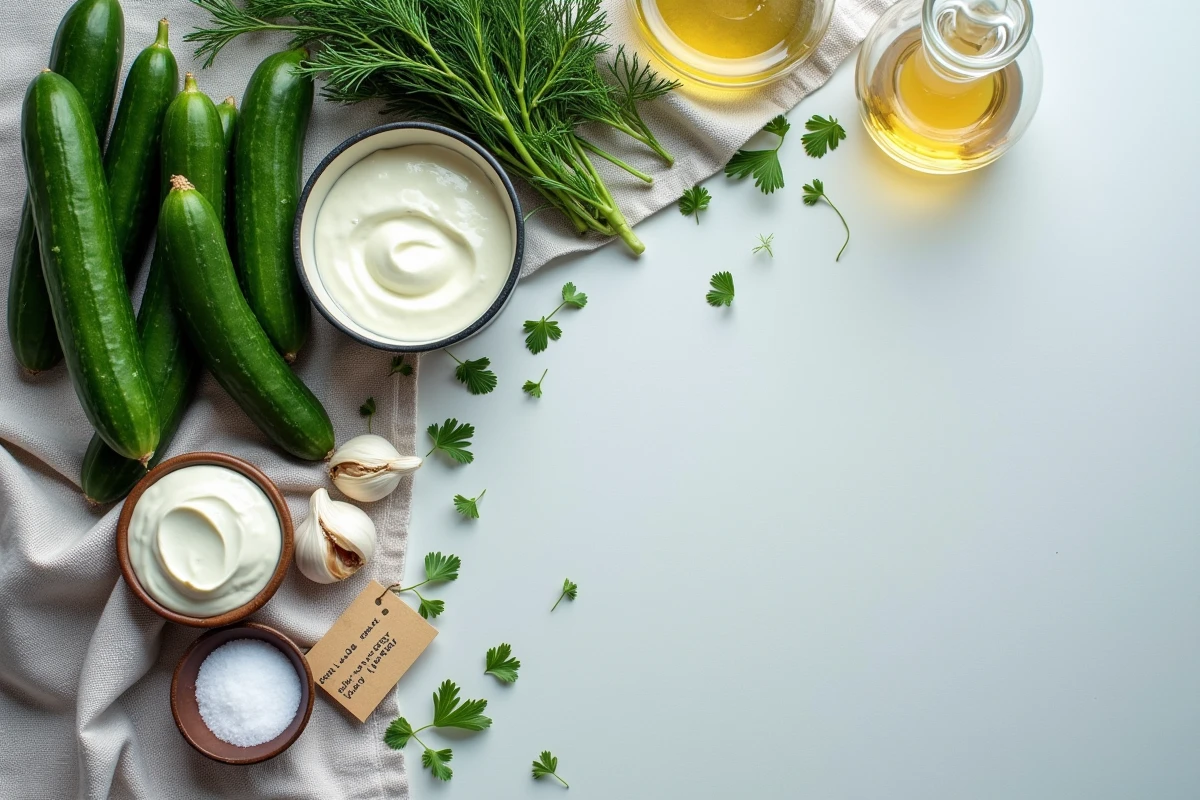
The choice of binder conditions the character of the dish. Thick fresh cream remains the classic base in France. It adds richness and roundness that cucumber, very watery by nature, does not provide alone.
Sour cream (or smetana), more acidic, directly refers to the Eastern European origins of the dish. It works particularly well with a less drained cucumber, as its acidity compensates for the excess water and enhances the flavors.
Greek yogurt, adopted by neo-bistros, brings a pleasant lightness in summer. While it loses some richness, the dish gains in freshness. Mixing two-thirds Greek yogurt and one-third fresh cream constitutes a compromise found in several recent bistronomic menus.
- Thick fresh cream: rich texture, sauce stability, classic taste. Ideal as an accompaniment to cold meats
- Sour cream or smetana: marked acidity, direct link to Central European tradition. Works well with smoked fish
- Greek yogurt: lightness, summer freshness, good base for adding herbs without weighing down the dish
- Cream-yogurt mix: balanced compromise, common in contemporary dining
Cucumber with cream remains one of those dishes where apparent simplicity masks real technical choices. The binder, the cut, the draining time, the type of herbs: each parameter alters the result. This is undoubtedly what explains why this recipe, despite its modest appearance, continues to circulate between family kitchens and restaurant menus, season after season.