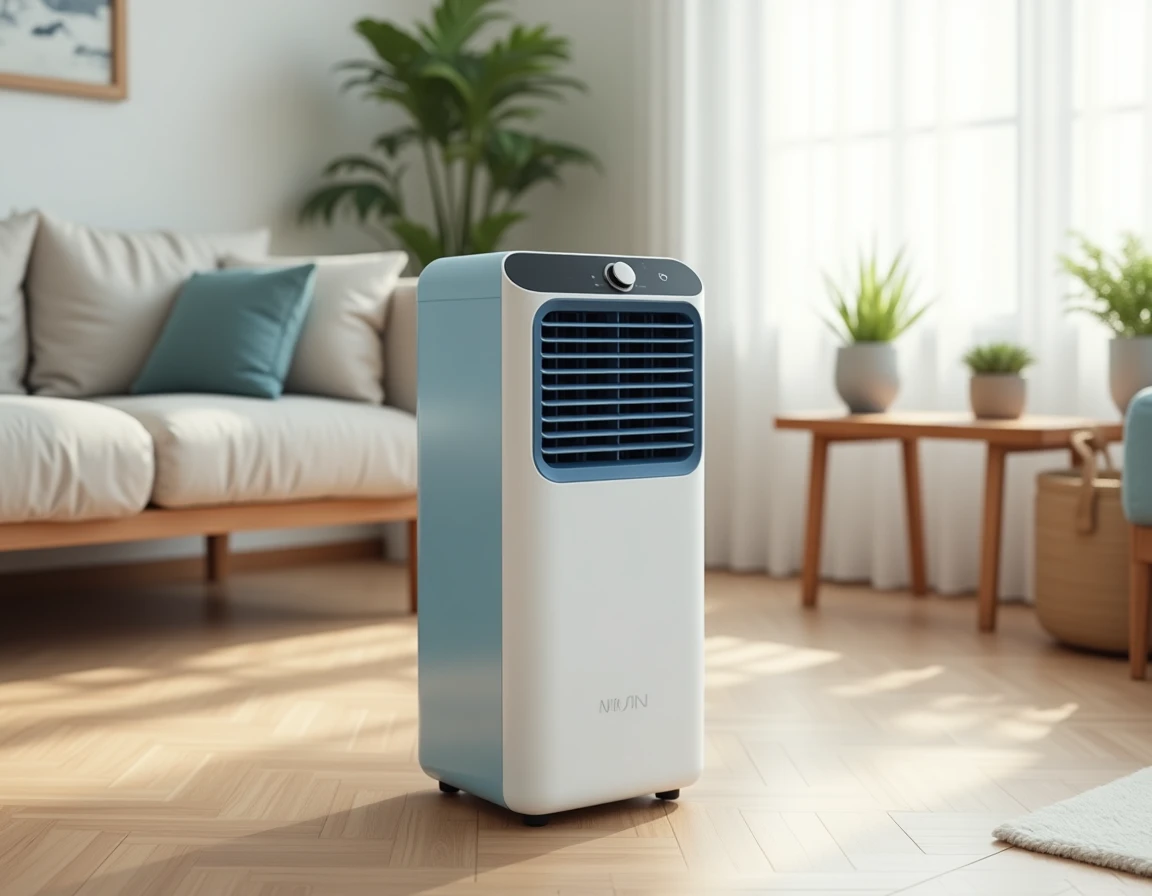
An evaporative air cooler operates on a simple principle: it draws in ambient air, passes it through a moistened filter, and releases a cooler airflow. The OneConcept Caribbean Blue applies this mechanism in a compact format, designed for supplementary home use. This device combines three functions (ventilation, cooling, humidification) in one unit, earning it the “3-in-1” designation found on product sheets.
Water Pump and Durability: The Weak Point Not Revealed by Short Tests
Most tests published online are based on a few weeks of use. The Caribbean Blue receives decent feedback, particularly regarding its ease of handling and the simplicity of its control panel. The problem arises later.
Customer reviews published between 2022 and 2024 on European marketplaces report a rise in negative feedback after two to three summers of continuous use. Water pump failures (stopping the flow of liquid to the filter) and broken wheels are frequently mentioned in these reviews.
This gap between a few days of testing and the experience over multiple seasons should be considered before purchase. A device at this price level remains a modest investment, but the replacement cost negates any savings if the pump fails by the third summer. For everything you need to know about the OneConcept Caribbean Blue, long-term feedback is a useful complement to technical sheets.
Evaporative Cooler and Heatwave: Real Limits of the Caribbean Blue
The evaporative principle has a structural weakness: its efficiency drops when ambient humidity exceeds a certain threshold. The more the air is already saturated with water, the less evaporation produces noticeable cooling.
During recent heatwave episodes in France, users reported a very small temperature difference between the ambient air and the air blown by this type of cooler. In regions where relative humidity rises above normal during heat peaks, the device operates more like a conventional fan than a true cooler.
When the Air Cooler Remains Relevant
The device retains its usefulness in well-ventilated rooms with dry or moderately humid air. Using it in conjunction with natural ventilation (windows open early in the morning, shutters closed during the day) produces a noticeable result.
- Moderate-sized room with regular air renewal, in a dry or temperate climate zone
- Occasional use during the hottest hours, not as a permanent cooling solution throughout the day
- Localized cooling directed towards a person or a workstation, rather than overall cooling of a dwelling
The ADEME classifies evaporative coolers as localized supplementary solutions, clearly distinguishing them from portable air conditioners that handle a larger volume of air (but consume much more).
Operation of the OneConcept Caribbean Blue: Control Panel and Reservoir
The Caribbean Blue offers three ventilation speeds, an oscillation mode to sweep a larger area, and a “Cool” button that activates the water pump. This pump circulates water from the reservoir to the evaporative filter, differentiating the cooling mode from the simple fan mode.
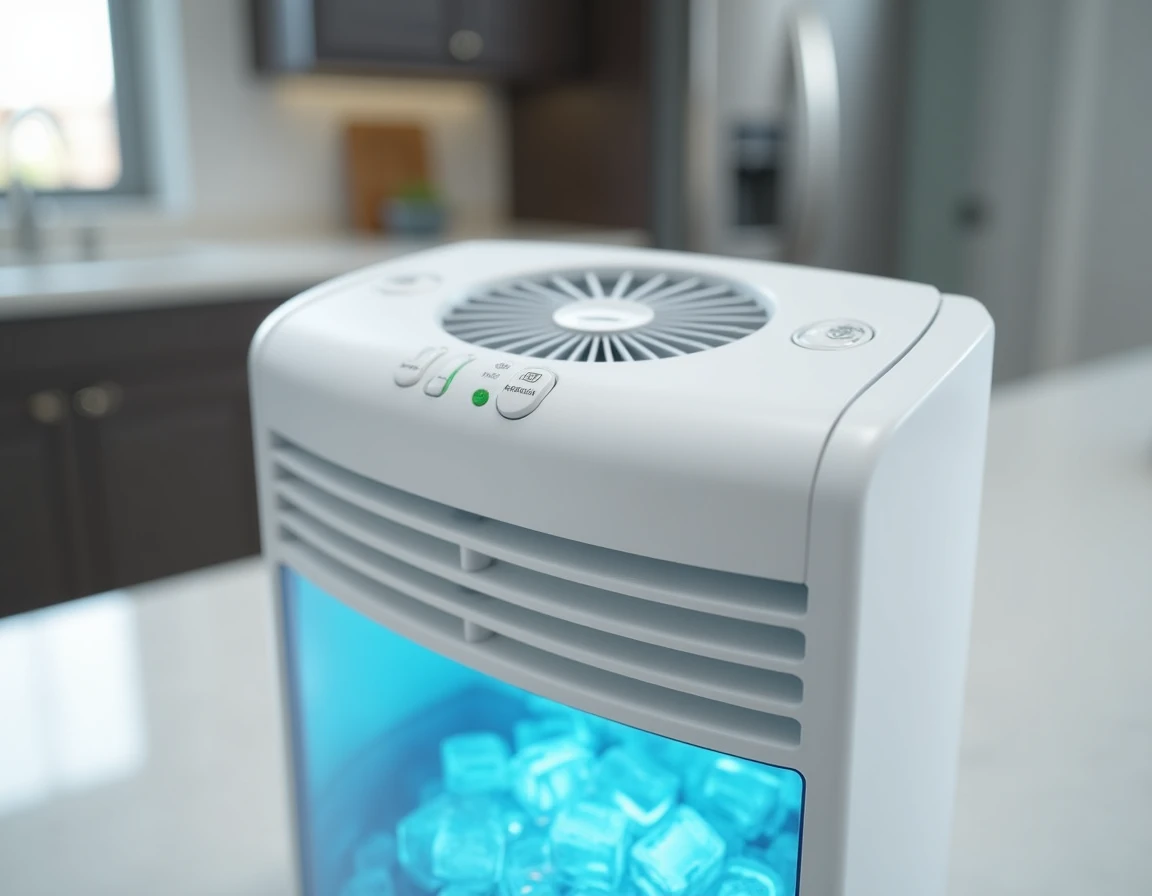
The water reservoir is filled from the back of the unit. OneConcept provides two small containers to place in the freezer and then slide into the tray. This ice pack system enhances the feeling of coolness during the first several minutes before the ice melts.
Filter and Tray Maintenance
The honeycomb filter should be rinsed regularly to prevent the buildup of limescale and bacterial growth. A reservoir left with stagnant water for several days generates unpleasant odors. The manual recommends cleaning after each prolonged use period, but in practice, a weekly rinse during the hot season is a minimum.
- Empty the reservoir after each session of several hours to limit stagnation
- Rinse the evaporative filter with clear water once a week during intensive use
- Check the pump’s condition at the beginning of the season: low or absent flow indicates clogging or failure
Air Cooler or Portable Air Conditioner: Concrete Selection Criteria
The confusion between these two categories of devices persists among many buyers. An evaporative cooler does not produce mechanical cold. It does not use a compressor or refrigerant fluid, which explains its significantly lower electricity consumption compared to a portable air conditioner.
In contrast, the perceived temperature drop remains limited and depends on ambient conditions. A portable air conditioner, even an entry-level model, mechanically cools the air and requires an exhaust to the outside (duct passing through a partially open window). The Caribbean Blue does not need this exhaust, making it easier to install and move from room to room thanks to its wheels.
The choice boils down to a question of priority: energy efficiency and mobility, or actual cooling power. For a studio or a bedroom in a moderately warm climate area, the cooler meets the need. In the face of repeated heatwaves in a poorly insulated apartment, the portable air conditioner remains more effective, despite its higher operating cost.
The OneConcept Caribbean Blue fulfills its role within a specific perimeter: localized cooling, ventilated room, air not too humid. Outside of these conditions, the comfort gain decreases rapidly. Before purchasing, the most useful question to ask is less about the model than about the type of device suited to one’s housing and local climate.