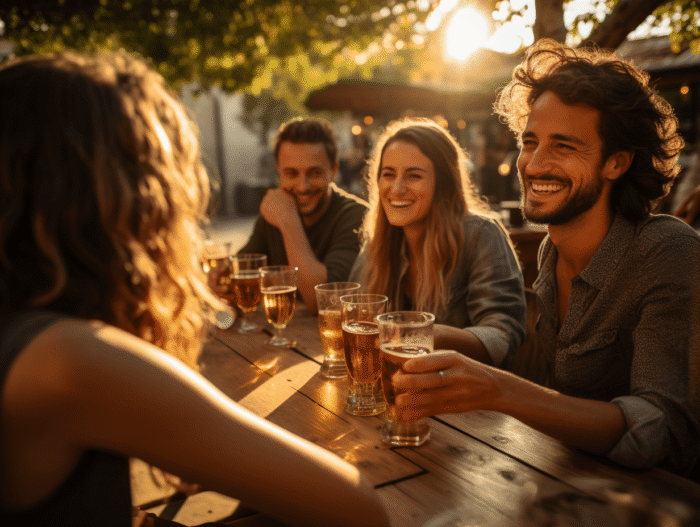
The enthusiasm of the French for anise-based aperitifs is rooted in a friendly and historical tradition. These drinks, with pastis as their flagbearer, symbolize moments of relaxation and sharing, particularly in the south of France. Their popularity transcends generations and is anchored in a French art of living, where the taste of Mediterranean flavors blends with the importance placed on social gatherings. The ritual of the aperitif, often accompanied by small dishes, is a facet of national culture, revealing an attachment to a certain refinement and authentic conviviality.
why pastis 51
The cultural origins of anise-based aperitifs in France
In discussing the origins of the anise-based aperitif, one figure stands out for his decisive influence: Paul Ricard. He is credited with the Pastis de Marseille, a drink that, since its creation in 1932, has established a harmonious balance between anise and licorice, and has managed to win the hearts of the French. Alcoholic beverages made from plants and spices found their cradle in the Bouches-du-Rhône, before spreading into national aperitif traditions.
The history of anise-based aperitifs is marked by innovations and adaptations to consumer tastes. While Pernod and Ricard remain flagship names, other brands such as Casanis, Berger, and Marie Brizard have also made their mark on the landscape of French spirits. But why has Pastis 51 emerged as a distinct reference within this category? It has managed to stand out, particularly with the introduction of 51 Rosé, which meets the demand for lower-alcohol drinks that are more suited to new consumption patterns.
Despite their cultural roots, anise-based spirits face the challenge of a rapidly evolving market, as evidenced by the 4% decrease in sales in volume reported by Nielsen. Brands must therefore demonstrate creativity to maintain their position and continue to be associated with the moments of conviviality that define the French aperitif.
The place of anise-based aperitifs in contemporary social practices
The pandemic has disrupted consumption habits, particularly those related to the aperitif. The influence of this health crisis on French social practices is undeniable, and the relationship with the aperitif has changed. The French, faced with restrictions, have reinvented this moment of sharing, adapting it to the constraints of the time: virtual aperitifs are the perfect illustration, uniting remote workers in a convivial moment despite the distance.
The ObSoCo, in a quantitative study, reveals that the aperitif remains an institution among CSP+ and men, who frequently organize it. This ritual takes various forms, from traditional dinner aperitifs to more informal gatherings among friends, partners, or family. The aperitif is thus confirmed as a vector of social connection, a moment of relaxation and exchange.
The French consider snackable aperitifs, such as crackers, pretzels, tiles, tortillas, puffed biscuits, peanuts, almonds, or cashews, as essential to these moments of conviviality. Private label brands (MDD), on the other hand, are penalized by taxes on spirits, yet their presence on French tables remains.
Cocktails, combining spirits and creativity, are experiencing a resurgence of interest and are making their way into aperitif evenings, proving their ability to associate with the conviviality of these moments. They illustrate the diversity and adaptability of the French aperitif, a characteristic trait of contemporary social practices.