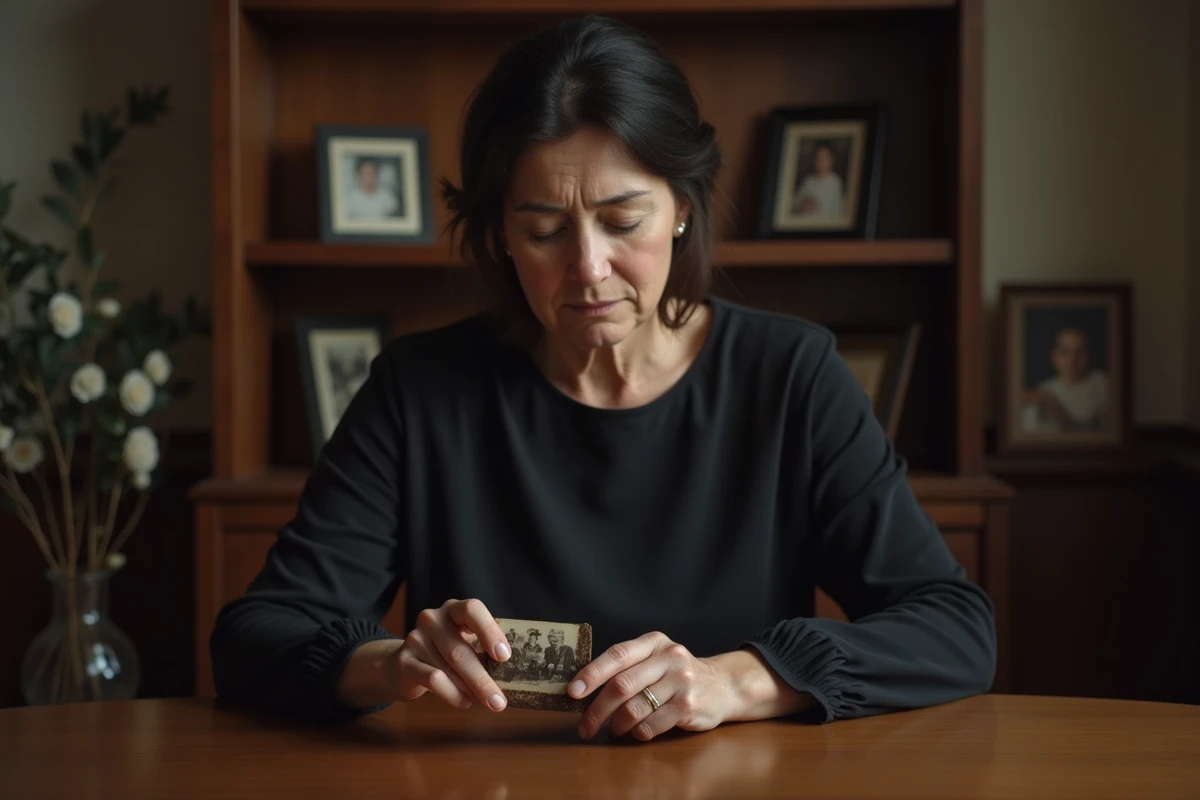
Nothing obliges one to speak at a farewell ceremony, but many feel the need to do so. Some words always seem too weak or too grand in the face of loss. Literary texts, including poems, circulate among hands, sometimes chosen at the last minute, sometimes written in urgency.
The choice of a poem for this moment is as much an intimate gesture as it is a response to an emptiness. Resources vary, between well-known classics and personal creations, to accompany the final tribute.
Why do words matter so much when saying goodbye to one’s mother?
Speaking at one’s mother’s funeral is much more than a formality. Every spoken sentence resonates like an echo of the past, a way to give shape to the absence. The departure of a mother leaves, in the child who has become an adult or is still young, an almost indescribable wound: absence settles in, but love does not fade.
When searching for the right word, whether writing or selecting a poem about a mother’s death, it is the uniqueness of the mother-child bond that asserts itself. The shared texts, poems, speeches, excerpts, become silent witnesses of attachment, but also a thank you for the tenderness received, the values transmitted, the reassuring presence. The tribute to the mother is rooted in living memory: daily gestures, softly spoken phrases, comforting silences.
In this context, words are not limited to carrying a message. They shape the pain, becoming the support for a longed-for soothing. With the reading of a poem, family and friends share not only their sorrow but also the conviction that maternal love does not disappear. Even if pronouncing these words requires courage or modesty, they trace a continuity: absence will never be total. It is inscribed in every memory, every word passed on, in the intimate lineage that connects a child to their mother.
Ideas for poems and texts to pay tribute at the funeral
Choosing words for a final tribute to one’s mother is much more than a fixed tradition. The poem often becomes the preferred form to convey the intensity of grief, gratitude, or affection. Some texts transcend generations through their evocative power or the sweetness of their imagery: “Death is nothing” by Henry Scott-Holland, “Tomorrow, at dawn” by Victor Hugo, or the Native American poem “To those I love”. Their verses, whether accessible or deeper, offer a space to gather sadness and revive memory.
Among the possible options, here are some inspirations that allow for adjusting the tribute to the personality of the deceased and the relationship experienced:
- A personal text recounting an anecdote, or a few lines borrowed from Antoine de Saint-Exupéry
- A quote from Paul Éluard: “The night is never complete”
- A passage from a psalm, like Psalm 23
Each of these texts reflects a shared story, an emotion, a gesture. Whether it is a child, a sister, or a friend reading aloud, the moment takes on an almost sacred dimension, where the words bring people together.
Adapting the poem to the family story, by evoking a memory, adding a name, or choosing an acrostic, emphasizes the unique dimension of the farewell. Some write a few words to be engraved on a plaque; others prefer a longer text to read together. Regardless of length: it is the sincerity of the bond, the trace of what has been transmitted, that gives the tribute its strength and sweetness.

Expressing personal grief: tips and examples for writing a sincere tribute
Writing a tribute to one’s mother is above all accepting that grief never resembles that of others. Some opt for discretion: a few whispered words, a letter placed in the coffin, or simply a stanza born from a bright memory. Others prefer a text that unfolds, in the background, the images of the night, the morning, or the stars, to express loss, but also tenderness, transmission, hope.
These personal gestures take various forms: lighting a candle of remembrance, creating a album gathering photos, letters, and little notes that tell the story of shared life. Gathering memory means giving a new presence to absence, bringing the mother back to daily life. Sometimes, a cherished object is placed during the ceremony, a beloved book, a flower, a scarf. Others, at times, share their experience on a forum dedicated to grief: the exchanged words provide comfort, and the collective voice soothes.
To write one’s own poem or message, it is often helpful to start from an emotion, a detail that has marked: a reassuring hand, a childhood scent, a phrase that one does not forget. Authenticity is key: express the pain, but also let gratitude or hope shine through. Some examples of formulations: “Your tenderness continues to accompany me,” “Your laughter lights up my nights,” “Your voice remains in the depth of silence.”
Here are several paths that can guide this writing process:
- Acrostic of the name, which personalizes the poem
- A letter addressed to the deceased, to say what could not be said
- Evocation of a significant memory, foundational of the bond
Through these gestures, poetry is not limited to naming absence: it becomes a passage, living music, a breath that connects generations. Words, even clumsy ones, have the power to hold one up, to unite the living around the one who is missed. So sometimes, it takes just a verse, a shared memory, for the light to break through the sorrow once again.