
With new-build developments becoming increasingly scarce, choosing a new-build property to live in means checking far more than the price per square metre or the advertised completion date. What concrete indicators can help distinguish a reliable development from a project weakened by the crisis?
New-build developments in 2026: a contracting market that changes the picture
The new-build housing crisis is about more than falling sales volumes. It is changing the very nature of the available supply. Several developers are scaling back launches, postponing construction work or abandoning projects because of insufficient sales.
For someone buying a home to live in, this contraction has a direct consequence: a development still being marketed today will not necessarily be completed. You can discover an upcoming new-build development on specialist platforms, but it is up to the buyer to verify the project’s actual status.
Before signing a reservation contract, ask the developer for three key pieces of information:
- The development’s sales rate (a pre-sales threshold, often around half of the units, is required before construction can officially begin)
- The status of administrative approvals (whether the building permit is free from any appeals or is still being challenged)
- How the project is financed, particularly the external financial completion guarantee (GFA), which protects the buyer if the developer defaults
A development whose building permit is subject to an appeal, or whose reservation rate has stagnated for several months, may be at risk of delay or even cancellation.
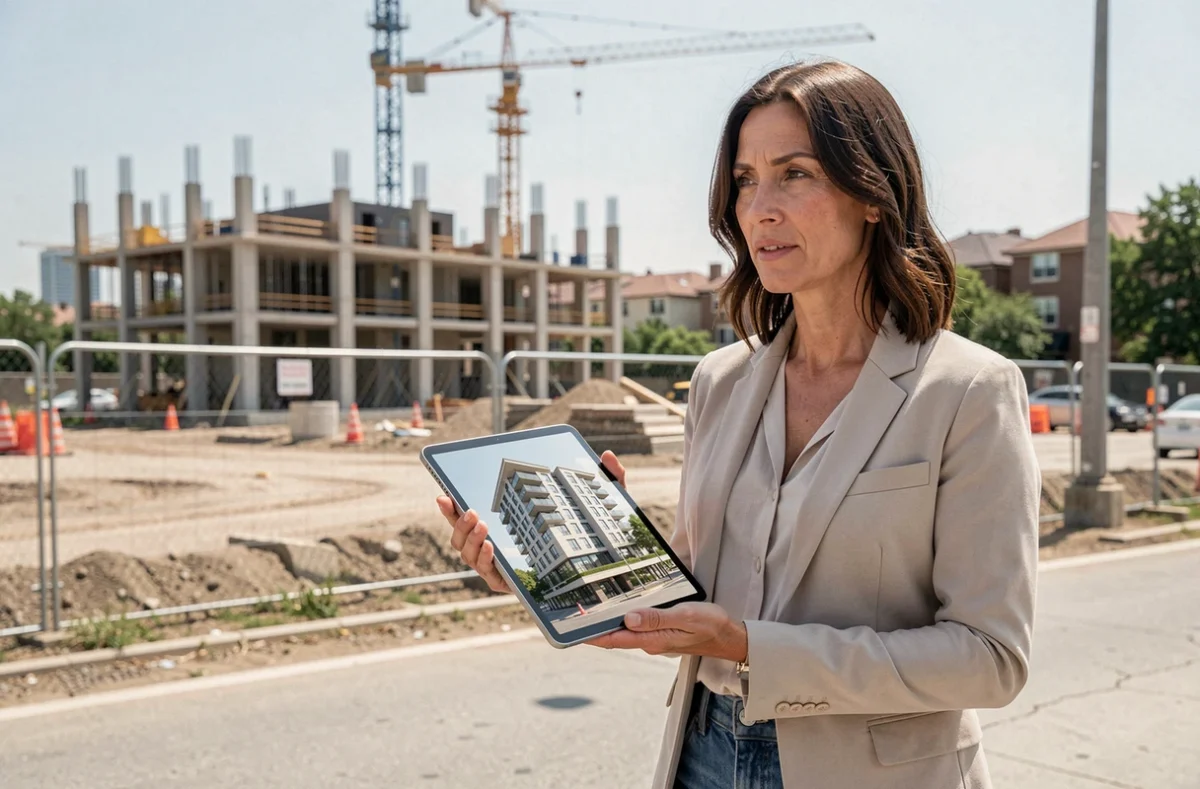
Primary residence or rental investment: comparing the selection criteria
Competing pages often mix advice for rental investors with guidance for future occupants. Yet their priorities differ in several important ways.
| Criterion | Primary residence | Rental investment |
|---|---|---|
| Floor area and layout | Suited to everyday use (storage, aspect, number of rooms) | Optimised for local rental demand (one- or two-bedroom flats in the city centre) |
| Location | Close to work, schools and everyday shops | Rental demand, employment hub and transport links |
| Estimated service charges | Direct impact on the household’s monthly budget | Kept low to increase net yield |
| Ownership period | Long term, linked to life plans | Variable, often aligned with a tax incentive scheme |
| Exit criteria | Comfort and quality of life | Resale potential or capital gain |
When buying a home to live in, how the property works in practice matters more than its theoretical return. The aspect of the living areas, ceiling height, noise levels from the immediate surroundings and storage layout matter more than the gross yield.
Checking a development’s viability before reserving
A completion date shown in a sales brochure is not a firm commitment. In the current climate, the actual start of construction is the only reliable indicator that a development is moving ahead.
The construction sector remains under pressure. Several building companies report shrinking order books and squeezed margins. This fragility in the construction supply chain can affect completion times, even for developments with permits free from appeal and strong sales progress.
Three practical checks to make
Ask the developer for the name of the organisation providing the external GFA to confirm that the guarantee is actually in place. Without an external GFA, a buyer purchasing off-plan bears the risk that the project will not be completed.
Checking the construction-site sign—or whether there is one at all—at the future development site provides a tangible indication. An empty plot with no sign several months after sales began may point to delays in the administrative process or a financing problem.
Reviewing the developer’s previous projects in the same city or department can provide a useful benchmark. A developer that has completed several projects within reasonable timeframes has a more reassuring track record than one with no local references.

Choosing a new-build development at neighbourhood level
Comparing two off-plan flats is not enough. The neighbourhood where a development is located has a significant bearing on future quality of life and the property’s long-term value.
Several factors are worth checking in person, rather than just online:
- Public transport links (actual service frequency, not just distance to a station)
- Nearby development plans (another housing project, a road or a business park) that could change the noise levels or views
- Shops and local services within walking distance
- The plot’s actual exposure to sunlight, which depends not only on its orientation but also on shadows cast by neighbouring buildings
A well-designed new home in an unsuitable neighbourhood is still a poor choice for a primary residence. Conversely, a standard flat in a pleasant, well-connected neighbourhood is easier to resell and offers greater day-to-day comfort.
The total cost of buying in a new-build development: beyond the advertised price
The sale price of an off-plan property represents only part of the actual cost. Reduced notary fees on new-build properties (around two to three per cent, compared with seven to eight per cent for older properties) are a genuine advantage. However, other costs are often underestimated.
Service charges in a new-build apartment block can come as a surprise, particularly in developments with shared facilities such as lifts, underground parking and maintained green spaces. Asking the developer for an estimate of annual charges before reserving makes it possible to include this cost in the monthly budget.
The cost of upgrades and customisations (choice of finishes, changes to partition walls, kitchen fittings) is added to the base price. Some developers include a budget for buyer-requested alterations in their offer, while others charge a premium for every change.
The scarcity of new-build developments in 2026 leaves less room to negotiate on price. This makes it all the more important to assess the full cost—including service charges and upgrades—before committing to a reservation.